When A Student Visa Gets Refused: Who Is Really Responsible?
In today’s study-abroad ecosystem, one question is becoming increasingly uncomfortable, but necessary. When a student visa is refused despite following the entire process, who is actually responsible?
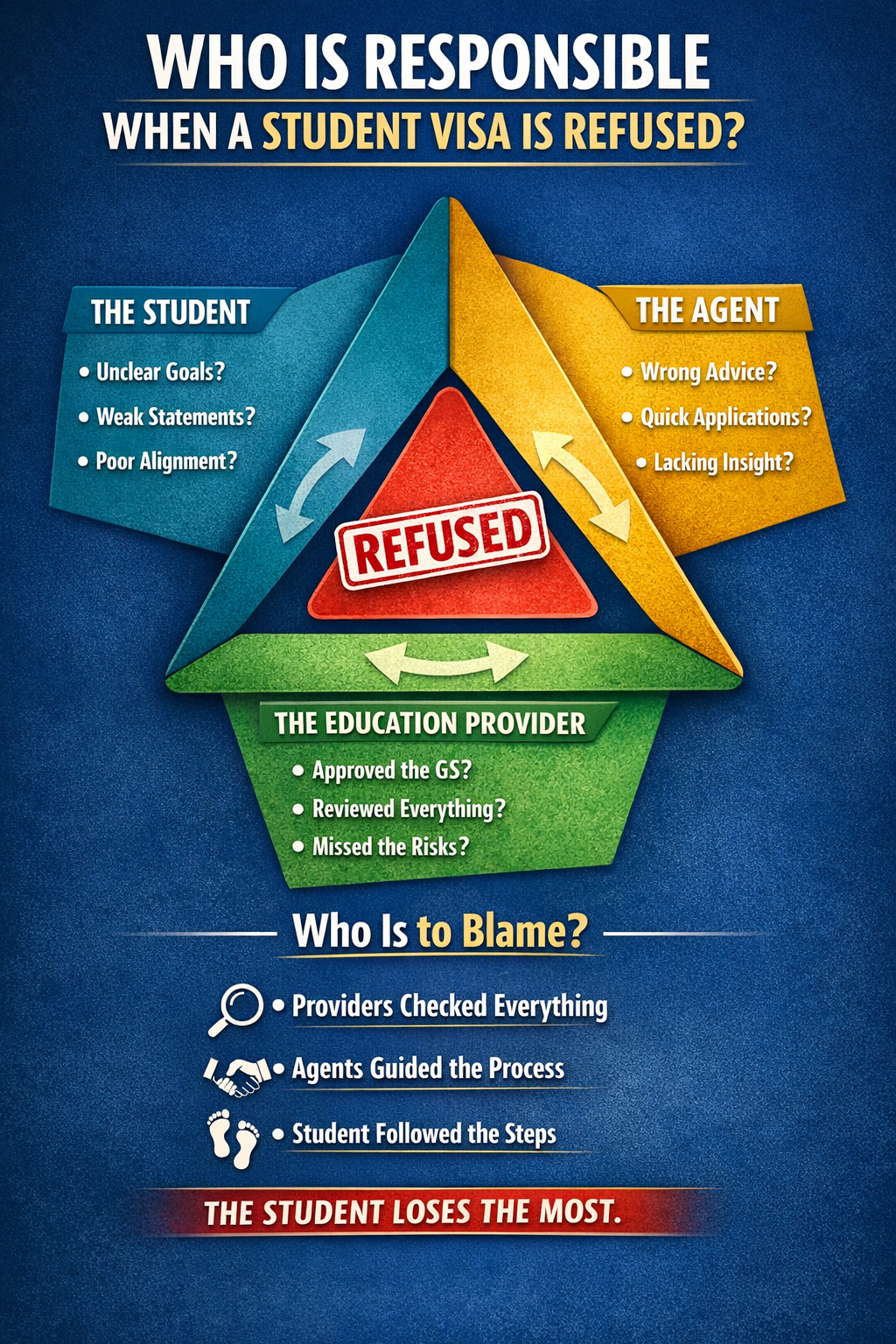
Is it the student? The education provider? Or the agent guiding the process?
The answer is not simple. But it is important. Understanding the Reality of the Process
Let’s first understand how structured and layered the process actually is.
A student does not directly apply for a visa blindly. There is a long chain of validation:
- Student prepares academic and financial documents
- Agent reviews, advises, and builds the Genuine Student (GS) profile
- Education provider assesses everything
- Financial capacity
- Academic progression
- Course relevance
- GS responses (often revised multiple times)
- Offer is issued
- Fees are paid
- Visa is finally lodged with the same GS narrative
This process involves multiple checkpoints. Yet, refusals still happen.
The Emerging Pattern: A Deeper Concern
From recent visa refusals, including the ones we have analysed closely, a clear pattern is emerging:
Visa decisions are increasingly being made based on the applicant’s own GS statements. Responses are being quoted, interpreted, and counter-argued directly. Even minor inconsistencies or weak positioning are being used as refusal grounds
This means one thing: The margin for error has become extremely small. So… Who Is Responsible?
Let’s break this down honestly.
1. The Student, Yes, the student plays a role.
- Lack of clarity in goals
- Unrealistic expectations
- Weak academic alignment
- Poor articulation of intent
But here’s the reality: Most students rely heavily on guidance. They are not experts in immigration frameworks.
2. The Agent / Consultant; Agents are responsible for:
- Strategic course selection
- Structuring the GS narrative
- Identifying risks before application
- Advising whether to proceed or not
However, the industry also has challenges:
- Some operate transactionally, not strategically
- Some push applications without full alignment
- Some lack updated understanding of refusal patterns
3. The Education Provider
This is where a critical question arises. Education providers:
- Review full financial documents
- Assess GS statements in detail
- Request multiple revisions
- Approve the application before COE
After such rigorous checks; If the same GS statement is later used to refuse the visa, what does that indicate? It raises an important structural gap. Alignment between provider assessment and immigration expectations is not always consistent. The Hard Truth: No One Controls the Final Decision Let’s be clear:
- Agents do not grant visas
- Providers do not grant visas
- Students cannot guarantee outcomes
Only immigration does.
But that does not mean accountability disappears.
The Real Issue: Misalignment, Not Just Mistakes From deep analysis, refusals today are less about:
- Financial insufficiency
- Missing documents
And more about:
- Intent clarity
- Course relevance
- Career logic
- Narrative consistency
In simple terms:
- It’s no longer about what you submit.
- It’s about how convincingly your story holds together.
Who Suffers the Most? When a refusal happens:
- The provider loses a student
- The agent loses effort and revenue
- But the student loses the most
Not just financially.
But emotionally.
- Lost time
- Lost confidence
- Sometimes even mental stress
And this is where the industry must reflect. A Critical Thought: Refusal vs Logical Refusal. There is a difference between:
- Logical refusal → helps the system improve
- Refusal without clear strategic reasoning → damages trust
The industry evolves only when decisions are:
- Transparent
- Consistent
- Aligned across stakeholders
The Way Forward: What Needs to Change. This is not about blame. This is about evolution.
- Stronger alignment between providers and immigration expectations
- More strategic, not transactional, counselling
- Students being educated, not just processed
- Honest risk assessment before application
Our Position at Education Park
At Education Park, we believe: A visa application is not a formality. It is a strategic narrative.
With:
- QEAC-certified counsellors
- Over 21 years of industry experience
- International recognition (PIEoneer Awards – Highly Commended, UK)
We focus on:
- Right course, not just any course
- Right student fit, not just approvals
- Right intent, not just documentation
Because in today’s environment: Right counselling is no longer optional. It is everything.
Final Thought
A refusal is never just a decision. It is a signal.
And the sooner we understand what that signal is telling us, the better we can protect the dreams we are trusted with.